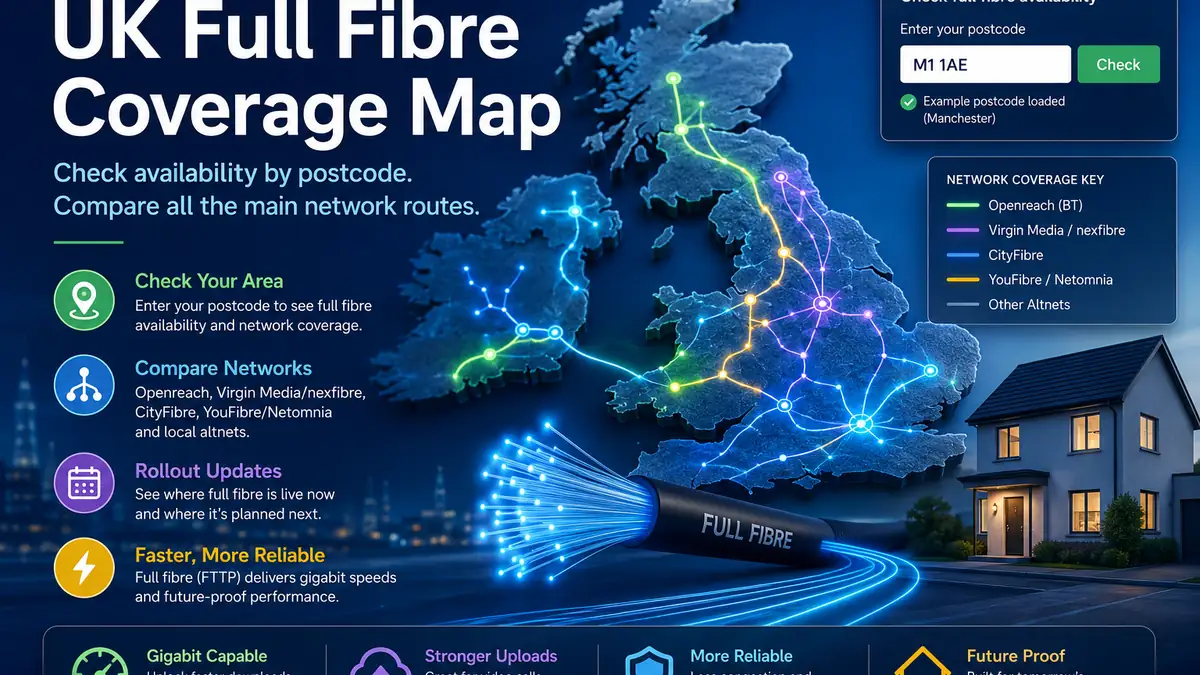
Use the map-led postcode lookup to understand local full fibre and gigabit coverage, then jump into exact-address provider routes when you are ready to verify or switch.
Map full fibre coverage first, then verify the provider route
Start with the map to see local FTTP and gigabit coverage context. Then use the availability checker to turn that result into a provider-route shortlist: Openreach, Virgin Media/nexfibre, CityFibre, YouFibre/Netomnia or another local altnet.
Postcode coverage lookup
Check local full fibre and gigabit coverage context
Enter a full UK postcode to get a compact local coverage verdict, map marker and next-step link into provider availability checks.
Loading ExampleLoading full fibre context for M1 1AE
A central Manchester example is shown first. Enter your own postcode for local results.
From map to order check
Next, verify the address with provider routes
The map shows rollout context. Ordering still depends on the exact property, installation route, wayleave and provider database.
Full fibre coverage is expanding fast, but it is still address-specific. Treat national coverage figures as a direction-of-travel signal, not a guarantee that your home, flat or business can order FTTP today.
🗺️
Coverage is high, but not universal
Full fibre reaches many UK premises, but remaining gaps can be highly local and availability still varies by address.
⚡
Check the technology, not just the speed
Confirm that the service is FTTP/full fibre rather than part-fibre, HFC cable, 5G or another connection type.
Live local mapOpenStreetMap embed v2
Loading the central Manchester sample map
Example map: M1 1AE, central Manchester
The example proves the map is working before you enter your postcode. Your result will replace it with the matched postcode centroid.
Spring 2026 data
📊 Loading central Manchester full-fibre stats
The preloaded M1 1AE example will be replaced as soon as you enter your postcode. The panel uses the LinkSpeed Ofcom/ONSPD database for matched local-area context.
📍 Council areaLoading example…
⚡ Full fibre footprintLoading…
🚀 Gigabit capableLoading…
📈 Full-fibre take-upLoading…
Recommended next step
Run a postcode lookup to unlock a local fix
If rollout is lagging locally, LinkSpeed will suggest a practical home-network guide while you wait for FTTP.
National coverage figures can hide local gaps. A postcode lookup can map your postcode to a local authority area, then show Spring 2026 Ofcom coverage metrics before you check the exact address with a provider.
Map note: this interactive map uses third-party OpenStreetMap embed v2 and centres on postcode-centroid data where available. It is still not a house-level service guarantee.
The postcode map gives local context. Use the broader LinkSpeed checker to review likely network routes, then confirm the exact address with the relevant provider before ordering.
One postcode, multiple networks
Check full fibre and gigabit routes for your address
Review likely routes across Openreach-based providers, Virgin Media/nexfibre, CityFibre partners, YouFibre/Netomnia and other local altnets from one postcode journey.
The address may be orderable, although installation can still depend on final connection work and engineer availability.
🛠️
Coming soon
The street may be in an active build, but dates can move. Keep the current service until the new installation is confirmed.
📅
Planned build
A network has signalled an intention to build, but delivery can still depend on civil works, permissions and demand.
⚠️
Not available
Check more than one network because Openreach, nexfibre, CityFibre and local altnets have different footprints.
Why two homes in the same postcode can get different results
Full fibre is delivered to individual premises. Flats, private roads, poles, underground ducts, blocked civils, wayleaves, new-build handovers and final fibre drops can all change the result from one address to the next.
🏢
Flats and MDUs
Apartment blocks often need building-owner permission before fibre can be installed throughout the property.
🪵
Duct and pole routes
One side of a street may use a different route from the other, especially in older areas.
🏘️
New-build estates
Coverage can depend on developer handover, network agreements and address-database updates.
🌾
Rural distances
Longer final drops, private land and wayleaves can affect installation times.
Confirm availability, then compare a provider route
The map shows local coverage context. Use the LinkSpeed availability checker and provider guides to confirm the exact address, package speeds and current offers before ordering.
Coverage evidence is based on LinkSpeed's Ofcom Connected Nations Spring 2026 dataset. Provider pages should be used to confirm current address-level ordering and package availability.
Check full fibre availability by UK city
Select a city to preload a central postcode into the FTTP checker. The map and local coverage panel will load automatically; replace the example with your exact postcode for the most relevant result.
Understand FTTP, address-level availability, copper migration and the difference between a regional map and an orderable service.
How does a UK full fibre coverage map work?
A UK full fibre coverage map combines postcode and local-area infrastructure data to show regional FTTP and gigabit context. It is a useful starting point, but the network or provider must still confirm the exact address before an order is placed.
What is full fibre broadband (FTTP)?
Full fibre, also called Fibre to the Premises or FTTP, runs fibre-optic cable directly to the property instead of stopping at a street cabinet. It removes the copper final leg used by FTTC and can support faster, more consistent download and upload speeds, although package speeds and symmetry vary by provider.
When is full fibre coming to my area?
Enter your postcode to review current local coverage, then check the relevant network's rollout or address checker. Planned-build dates can move because of street works, permissions, blocked ducts and final installation requirements.
Why isn't full fibre available at my exact address?
A postcode can contain properties served by different poles, ducts, distribution points or building-entry routes. Blocked ducts, wayleaves, landlord permission, engineering capacity, new-build handovers and incomplete address records can all delay one property after nearby premises become serviceable.
Is my current broadband full fibre?
Not necessarily. If your service is described as FTTC, VDSL or part fibre, fibre normally stops at the street cabinet and copper completes the route to the property. FTTP or full fibre usually includes an optical network terminal inside the premises, but confirm the connection technology in your contract or with the provider.
How do I check YouFibre and Netomnia coverage?
Use the postcode checker for local context, then confirm the exact address through YouFibre. YouFibre is the retail service commonly delivered over the Netomnia infrastructure network, so build and order status can vary by street.
How do I check nexfibre availability by postcode?
Run the postcode lookup for local context, then use the official Virgin Media address checker to confirm whether the property is served by legacy HFC cable or newer XGS-PON nexfibre full fibre.
Why can my neighbour get FTTP when I cannot?
Neighbouring homes can have different ducts, poles, wayleaves, database records or final-drop routes. A nearby live service therefore does not always mean your property is immediately orderable.
What happens to my old copper phone line?
Openreach plans to retire the analogue Public Switched Telephone Network by 31 January 2027, so traditional landline voice services are moving to digital voice. This does not mean every physical copper cable disappears on that date: where FTTP is unavailable, broadband may continue over a copper-based access product while the wider full-fibre migration continues. Your provider should confirm what changes at your address.
Check your address
Is full fibre available at your postcode?
Return to the postcode tool to load the local map and coverage data for your area.