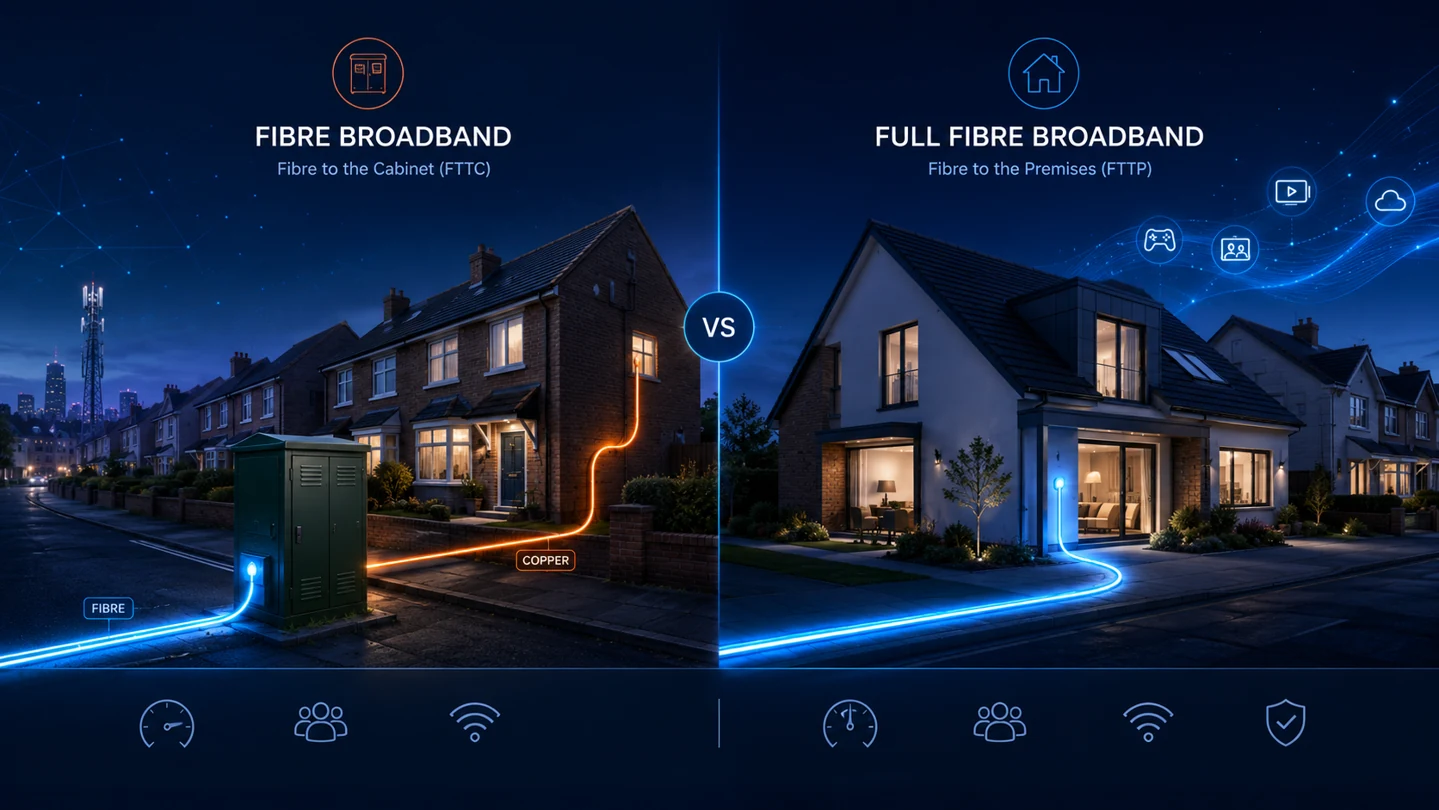
FTTC vs FTTP vs Cable vs 5G: What Changes?
Use this table to separate the marketing label from the actual connection type. The final link into the property usually explains why two “fibre” packages can feel very different.
| Connection type | How it reaches the home | Practical strengths | What to watch |
|---|---|---|---|
| FTTC fibre | Fibre to the street cabinet, then copper to the property. | Often good enough for browsing, HD streaming, light work and smaller households. Typical top tiers are around 80 Mbps download and 20 Mbps upload. | Long copper lines can reduce real speeds below the package headline, especially for upload-sensitive work. |
| FTTP full fibre | Fibre runs all the way to the property, usually ending at an ONT inside the home. | Best long-term choice for higher speed tiers, stronger upload, busy homes and future upgrades. Common packages range from 100 Mbps to 1 Gbps+, with some networks offering symmetrical options. | Availability is address-specific; installation may require an ONT, engineer work, wayleave checks or external cabling. |
| Cable broadband | Usually a cable network rather than Openreach FTTC or FTTP; some areas are moving to full fibre. | Can deliver very high download speeds and strong household capacity in covered areas, including gigabit-class tiers on some networks. | Upload may still be much lower than download, so check the package ratio and test loaded latency at peak time. |
| 5G home broadband | A cellular router connects to the mobile network rather than a fixed cable into the property. | Useful where fixed-line options are weak or where fast deployment matters. | Signal quality, mast load, router position, band switching and peak-time variation need testing. |
What is fibre broadband?
In UK broadband advertising, fibre broadband usually means FTTC rather than full fibre. It is a part-fibre connection: fibre reaches the street cabinet, then the final copper section sets much of the real-world speed limit.
Speed reality check: FTTC packages typically top out around 80 Mbps download and 20 Mbps upload, and longer or poorer copper lines can be lower. That can still be enough for lighter households, but it leaves less headroom for large uploads, cloud backups and busy working-from-home use.
What is full fibre?
Full fibre, or FTTP, removes the copper cabinet-to-home leg. Fibre reaches the property and normally connects to an ONT before your router, giving the network far more room for higher speed tiers and stronger upload performance.
Speed reality check: FTTP commonly supports packages from around 100 Mbps to 1,000 Mbps+. Upload speeds vary by provider and package, but full fibre generally scales much better than FTTC, and some full-fibre networks offer symmetrical download and upload tiers.
FTTC ceiling
Usually up to around 80 Mbps down and 20 Mbps up before copper line length and quality reduce the real result.
FTTP headroom
Commonly sold from entry-level full fibre through to 900 Mbps, 1 Gbps and beyond, depending on network and provider.
Cable context
Cable can offer gigabit-class downloads, but upload speed and loaded latency should still be checked separately.
Why marketing terms can be confusing
Some broadband adverts simply say “fibre” without making it obvious whether the service is FTTC or FTTP. That does not necessarily mean anything is wrong — it just means you should check the connection type carefully if you specifically want full fibre.
A provider page or checker may mention terms like:
- FTTC — fibre to the cabinet
- FTTP — fibre to the premises
- Full fibre — usually another way of describing FTTP
- Gigabit broadband — often available over full fibre, though not every full fibre package is gigabit
Speed is not the only difference
People often focus on headline download speeds, but there are other practical differences too.
Upload performance
Full fibre usually gives better upload speeds, which helps with video calls, sending large files, cloud storage and livestreaming.
Consistency
FTTP is generally less dependent on copper-line quality and cabinet distance, so performance can be more predictable.
Future-proofing
Full fibre is the more future-facing option for households expecting more devices and more demanding online activity.
Which should I choose?
Choose full fibre if it is available at your address and the price and contract terms suit you. It is usually the stronger all-round option for performance and long-term flexibility.
Choose standard fibre broadband if:
- full fibre is not yet available where you live
- your usage is relatively light
- the FTTC package is significantly cheaper and still meets your needs
For browsing, HD streaming and lighter household use, FTTC may still be enough. For heavy use, working from home, gaming, 4K streaming and lots of simultaneous devices, FTTP is usually the better fit.
How to tell what you currently have
If you already have broadband and are unsure whether it is FTTC or FTTP:
- Check your provider account or contract summary.
- Look for wording such as FTTC, FTTP, full fibre or gigabit.
- Use an address-level availability checker.
- Compare your real speed-test results with your package description.