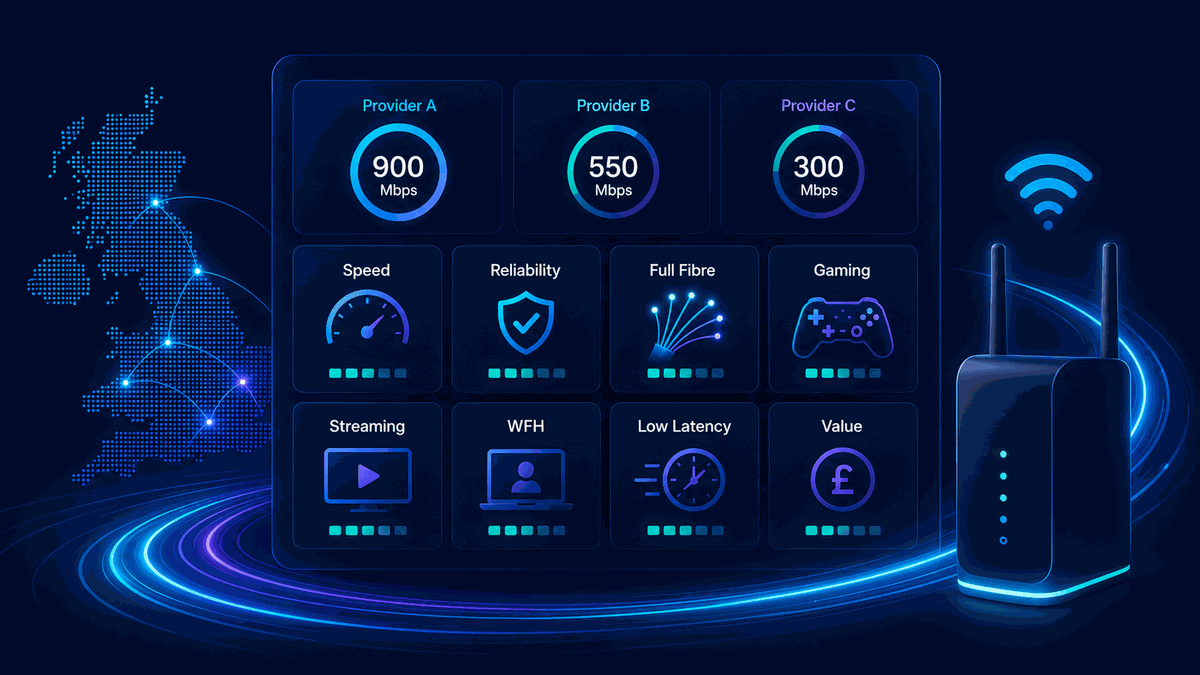
Sky and BT can use the same Openreach FTTC or FTTP access line at your address, so the real difference is usually router hardware, Wi-Fi coverage, TV bundles, support, pricing and the wider BT/EE or Sky ecosystem.
Provider comparison guide
Sky vs BT: compare Openreach lines, routers and TV bundles
Sky and BT often share the same Openreach FTTC or FTTP access line, so the consumer decision usually moves to Wi-Fi hardware, TV ecosystem, router features, support, pricing and whether you now prefer the BT/EE route.
Start with the shared-line reality. If both services use the same Openreach line at your address, the raw access speed and physical line reliability should be similar. The differences show up in the router, Wi-Fi, routing, bundles and contract experience.
Interactive selector
Sky vs BT/EE household ecosystem matcher
Because Sky and BT often use the same Openreach line, the better choice can depend on TV preferences, existing EE mobile accounts, Wi-Fi coverage needs and how you want to manage streaming services.
Match the provider to your household
Tick the options that apply. The live result leans toward Sky or BT/EE based on entertainment, mobile, Wi-Fi and streaming priorities.
Recommended route
Select priorities
Tick your household priorities to see whether the Sky entertainment route or BT/EE ecosystem fits better.
Hardware and bundle matrix
Sky vs BT/EE: router, Wi-Fi and TV comparison
If both providers use the same Openreach FTTC or FTTP access network at your address, this is where the real comparison starts.
Comparison metric
Sky broadband profile
BT / EE broadband profile
What it means
Physical core network
Usually Openreach FTTC or Openreach FTTP, depending on address.
Usually Openreach FTTC or Openreach FTTP, depending on address.
Where the access line is identical, raw line speed and physical reliability should be similar.
Router route
Sky hub hardware, with Sky Max Hub / Sky WiFi Max options depending on package.
BT Smart Hub or newer EE Smart Hub route depending on package and migration path.
Router generation, Ethernet ports and mesh options can affect real home performance.
Wi-Fi guarantee
Sky WiFi Max and Sky pods may suit TV-first households needing wider coverage.
EE Smart WiFi discs and EE hub options may suit larger or thicker-walled homes.
Compare the cost, guarantee wording and number of extender/pod options.
TV integration
Strong fit for Sky Stream, Sky Glass and Sky entertainment packages.
Strong fit for EE TV, Apple TV 4K-style integrations and EE mobile bundles.
Choose the ecosystem you already use rather than judging broadband alone.
Gaming and latency
Baseline access ping should be similar if the same Openreach line is used.
Baseline access ping should be similar if the same Openreach line is used.
Test Wi-Fi, routing, loaded latency and device placement before blaming the line.
Technical differences
The Openreach reality: why Sky and BT can share the same line
Sky and BT are not usually two separate physical broadband networks at the access-line level. At many UK addresses, both providers sell service over the same Openreach infrastructure. That could mean FTTC / Fibre-to-the-Cabinet part-copper broadband or FTTP / Fibre-to-the-Premises full fibre terminating at an ONT / Optical Network Terminal.
That means the maximum access-line speed, basic physical stability and weather resilience may be very similar where both providers use the same Openreach technology. The practical differences usually come from package tiers, ISP routing, Wi-Fi hardware, support, price structure and bundle fit.
Sky route: Sky Max Hub and TV-first bundles
Sky can make more sense when your broadband decision is tied to the wider Sky entertainment route. Sky Stream, Sky Glass and Sky WiFi Max can be useful if the living-room experience is the main priority.
Sky Max Hub: a Wi-Fi 6-focused route on eligible packages, often paired with Sky WiFi Max and pods.
TV ecosystem: strong fit for households already committed to Sky entertainment, sport, cinema or streaming hardware.
Line reality: if Openreach FTTP is the access line, the physical fibre route is not unique to Sky.
BT/EE route: Smart Hub, EE ecosystem and mesh
BT Group has increasingly positioned consumer broadband, mobile and TV around the EE ecosystem, so modern package comparisons should include both BT and EE-badged hardware routes.
BT / EE Smart Hub route: compare the supplied hub, Ethernet options, mesh discs and Smart WiFi features for your package.
EE mobile and TV fit: worth checking if your household already uses EE mobile or wants EE TV / Apple TV 4K-style integrations.
Legacy copper: G.fast or FTTC availability may still appear in some areas, but FTTP is the long-term full-fibre route.
Check the access technology first. If both providers use the same Openreach FTTP line at your address, the decision is more likely to come down to router hardware, Wi-Fi coverage, TV bundles, support and total contract cost.
After installation, repeat your speed, ping and loaded-latency checks so you can compare the new Sky or BT/EE service against your old baseline.
Buying checks
How to choose when the underlying line is the same
Do not assume Sky or BT is automatically faster if both are using the same Openreach FTTP line. Instead, compare router generation, Ethernet requirements, mesh cost, TV bundles, mobile discounts, support, contract length, annual price-change wording and installation timing.
If you work from home or game, focus on the home network as much as the provider. A poor Wi-Fi layout can make a good FTTP line feel slow, while a wired device and sensible router placement can make the same line feel far more stable.
Next guides
Useful next steps
Compare Broadband hub
Return to the main comparison hub for provider, technology and use-case guides.
In many areas, yes. Sky and BT commonly deliver fixed broadband over the Openreach access network, so the physical FTTC or FTTP line can be the same at a given address.
Does Sky or BT have lower ping for gaming?
If both providers use the same Openreach FTTP line, baseline access latency should be very similar. Differences are more likely to come from router performance, Wi-Fi, routing, local congestion and loaded latency.
Sky Max Hub vs BT or EE Smart Hub: which matters more?
The router matters most inside the home. Compare Wi-Fi generation, Ethernet ports, mesh options, device handling and any smart Wi-Fi guarantees before choosing.
Should I choose Sky or BT if I already have Sky TV?
Sky may be simpler if you want Sky Stream, Sky Glass or premium entertainment bundles managed in one place. BT/EE may fit better if you use EE mobile or want the EE TV and Smart WiFi ecosystem.
What should I test before switching from Sky to BT or BT to Sky?
Run a broadband speed test, ping test and bufferbloat test before switching, then repeat after installation. This shows whether the change improved real speed, latency and loaded latency.