Ultra High Reliability
UHR means the focus moves from headline speed alone to steadier connections, fewer random drops and better performance when many nearby networks are active.
Wi‑Fi 8 is the future wireless standard focused on Ultra High Reliability, lower latency, stronger roaming and more consistent home Wi‑Fi in busy environments.
Future home networking
Wi‑Fi 8, also known as IEEE 802.11bn, is expected to focus on Ultra High Reliability, steadier latency, smarter channel sharing and better device coordination in crowded homes.
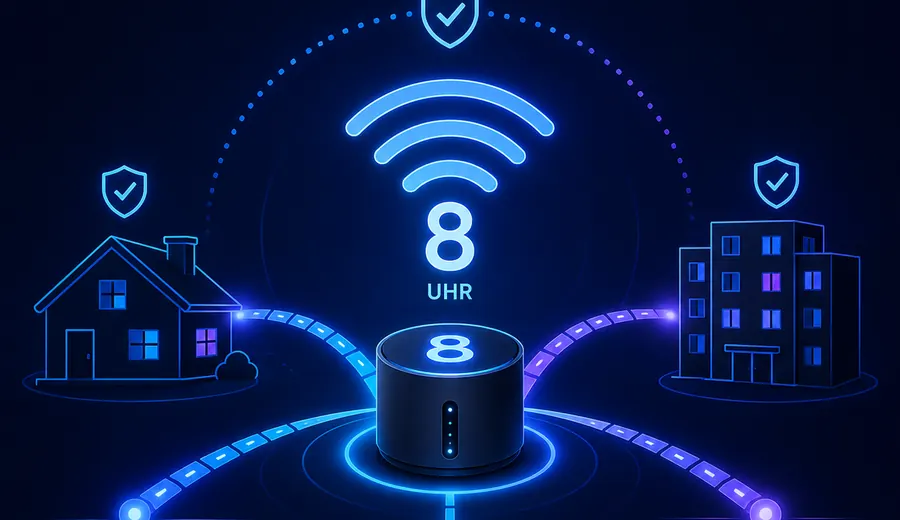
Wi‑Fi 8 (IEEE 802.11bn) is the next-generation wireless standard currently moving through the IEEE draft process, with final TGbn approval milestones projected for 2028 and UK consumer hardware timing dependent on vendors and certification. Unlike older standards focused on peak speeds, Wi‑Fi 8 prioritises Ultra High Reliability (UHR), lower latency spikes and smarter channel coordination.
Definition
Wi‑Fi 8 is the expected next generation after Wi‑Fi 7. The important shift is that the standard is being built around Ultra High Reliability, usually shortened to UHR.
UHR means the focus moves from headline speed alone to steadier connections, fewer random drops and better performance when many nearby networks are active.
Gaming, video calls, cloud gaming and remote work benefit when delay stays predictable instead of bouncing up and down.
Future routers, mesh nodes and client devices should coordinate more intelligently in busy homes, flats and terraces.
Short Video Guide
Watch the LinkSpeed overview of Wi‑Fi 8, IEEE 802.11bn and Ultra High Reliability, including why the next generation is aimed at steadier latency, better coordination and more reliable performance in busy homes.
The video is a quick overview; the technical sections below cover the IEEE targets, DSO, DRUs, multi‑AP coordination and the expected UK timeline in more detail.
Interactive decision tool
Answer two or three questions. The advisor separates coverage, congestion, router and broadband-line problems from genuine future-upgrade planning.
Compare standards
Wi‑Fi 7 is the premium upgrade available now. Wi‑Fi 8 is the future reliability upgrade to watch, but it is not a reason to leave poor Wi‑Fi unfixed today.
| Feature | Wi‑Fi 7 | Wi‑Fi 8 focus | What it means at home |
|---|---|---|---|
| Core theme | Very high speed, 6GHz support and Multi‑Link Operation on compatible gear. | Ultra High Reliability for steadier real-world performance. | Wi‑Fi 8 is expected to care more about consistency than bigger marketing numbers. |
| Latency | Can be excellent when signal is strong and hardware supports the features. | Designed to reduce local wireless spikes and improve predictability. | Useful for gaming, calls and cloud services, but your broadband route still matters. |
| Channel width | Up to 320 MHz channels on compatible 6 GHz hardware. | Expected to retain the same 320 MHz channel width rather than simply chasing wider channels. | The main gain is steadier real-world performance, not a larger headline channel number. |
| Modulation | 4096‑QAM can improve peak rates when signal quality is excellent. | Expected to retain 4096‑QAM while improving reliability around busy, imperfect real homes. | Better radios still need good placement; modulation alone does not fix dead zones. |
| Busy neighbours | Can handle congestion better than older standards. | Coordinated Spatial Reuse (CoSR) and smarter sub-channel handling should reduce airtime conflicts. | Better for flats, terraces and dense streets where many networks overlap. |
| Device coordination | Multi‑Link Operation can combine or switch links on compatible Wi‑Fi 7 gear. | Coordinated Beamforming (CoBF) should help routers and access points aim signal energy more intelligently. | Future mesh and multi-access-point homes should feel smoother as devices move around. |
| Mesh networks | Strong premium mesh option today. | Expected to improve coordination, roaming and reliability over time. | Future mesh systems should feel smoother as devices move around the home. |
| Buying decision | Relevant now for gigabit broadband and newer devices. | Worth monitoring as the standard progresses toward its 2028 approval milestones. | Do not wait if you already have dead zones or unstable Wi‑Fi. |
Technical data
Wi‑Fi 8 is not expected to be a simple speed-number jump. The high-value terms sit underneath Ultra High Reliability: smarter spectrum use, distributed resource allocation and tighter coordination between access points.

Quick glossary
Use these quick definitions if you want the short version before reading the deeper technical sections below.
DSO monitors a wide channel in smaller slices. If only one 20 MHz or 40 MHz portion becomes noisy, Wi‑Fi 8 can reduce reliance on that affected part and keep traffic flowing on the cleaner slices.
DRUs spread a device’s assigned tones across separated parts of the channel instead of one continuous block. That makes narrow-band interference less likely to damage the entire transmission and can help weaker uplinks stay usable.
CoSR helps nearby access points reuse airtime more cleanly. Instead of every radio transmitting as aggressively as possible, they coordinate power and timing so neighbouring Wi‑Fi networks interfere less with one another.
CoBF steers signal energy more intelligently toward active devices while reducing wasted energy toward nearby access points. In practice, that can improve signal quality and lower local background interference in mesh-heavy homes.
Wi‑Fi 8 is expected to retain the same headline 320 MHz channel width introduced with Wi‑Fi 7 on compatible 6 GHz hardware. The engineering focus shifts toward making that spectrum more dependable when the air is busy.
4096‑QAM remains a peak-speed feature for excellent signal conditions, but Wi‑Fi 8 aims to make normal busy-home performance more predictable instead of relying on ideal lab conditions.
DRUs spread a device’s assigned tones across non-contiguous parts of a wider channel instead of forcing every transmission into one continuous block. That can make the link more resilient to narrow-band interference and can improve uplink behaviour for lower-power client devices at range.
Wi‑Fi 8 is designed to improve how neighbouring access points and mesh nodes coordinate airtime, power and antenna behaviour. The goal is less self-interference and more predictable whole-home performance when several radios are active at once.
Coordinated Beamforming lets access points use antenna steering more intelligently, aiming useful signal energy toward active clients while reducing unwanted energy toward neighbouring access points. In multi-AP and mesh environments, that can lower local background interference and improve link quality.
Coordinated Spatial Reuse allows nearby access points to negotiate transmit power and airtime based on current link conditions. That makes it easier for mesh nodes—or even networks in adjacent flats—to reuse the same spectrum without unnecessarily crushing each other’s throughput.
Technical shift
Instead of treating a wide 320 MHz channel as one rigid block, Wi‑Fi 8 introduces Dynamic Sub‑Band Operation (DSO), sometimes described as dynamic sub-channel operation. The router and client can respond more intelligently to interference affecting only part of a wider channel instead of allowing one busy segment to drag down the whole transmission.
If a 20 MHz or 40 MHz part of the wider channel becomes heavily congested, DSO is designed to reduce reliance on that affected portion and keep more useful traffic flowing across cleaner spectrum.
The benefit is not a larger headline channel width. It is greater resilience when neighbouring routers, mesh nodes or other transmitters create uneven interference across the band.
TP-Link’s published Wi‑Fi 8 material cites early test results of up to 24% better interference handling and up to 30% higher real-world throughput in selected heavy-load scenarios versus Wi‑Fi 7. These figures are vendor test claims, not guaranteed gains for every home.
This matters in UK terraces, blocks of flats and dense streets where several routers compete in the same airspace. The goal is not a higher vanity speed label, but preventing performance from falling sharply when one part of the channel becomes crowded.
Spectrum resilience
DRUs take the same reliability idea a step further. Instead of assigning a device one continuous chunk of spectrum, Wi‑Fi 8 can distribute its resource tones across separated parts of the channel. In practice, that means a narrow pocket of interference is less likely to damage the entire transmission.
Data can be spread across non-contiguous sub-carriers so a local interference spike does not wipe out one large, continuous allocation.
Client devices such as phones, cameras and IoT gear often transmit with less effective power than the access point. DRU-style distributed allocations can improve tone use and help those lower-power uplinks remain usable at the edge of coverage.
The practical target is fewer sudden stalls, retries and dead-zone-like failures when the link is weak or the surrounding spectrum is unevenly congested.
For today’s homes, you can often get more immediate improvement by fixing router position, checking whether UK building materials are blocking Wi‑Fi, or choosing mesh Wi‑Fi with the right backhaul.
UK timeline
IEEE 802.11bn is still being finalised. The current IEEE TGbn project timeline targets final working-group approval in March 2028 and RevCom / Standards Board approval in May 2028. Consumer hardware can appear before or after final approval, so UK availability should be treated as a vendor-led rollout rather than a fixed launch date.
If you have a dead zone, weak upstairs signal or unstable video calls today, waiting for Wi‑Fi 8 is the wrong fix.
While Wi‑Fi 8 is the future, Wi‑Fi 7 is the standard available right now for gigabit full fibre and multi-band hardware setups. Read our Wi‑Fi 6 vs Wi‑Fi 7 technical comparison to see if current features like MLO match your home requirements.
If your current Wi‑Fi is already stable, Wi‑Fi 8 is worth monitoring before a major future hardware refresh.
Before waiting for Wi‑Fi 8
If you are considering Wi‑Fi 8 because gaming, calls or streaming feel unstable today, test the fault before buying or waiting. A room-only drop usually points to local Wi‑Fi coverage; high loaded latency points to bufferbloat or router queueing; poor results beside the router may point to the line or provider equipment.
Run LinkSpeed beside the router, then repeat in the weak room. A sharp Wi‑Fi-only drop means router placement, mesh Wi‑Fi or Ethernet may help now.
Uploads, downloads and router queues can cause lag even when headline speed looks fine.
Run Bufferbloat & Loaded Latency TestIf only one office, bedroom or TV room fails, use the slow Wi‑Fi in one room checklist before blaming the Wi‑Fi generation.
If the problem follows a floor or wall path, compare the slow upstairs Wi‑Fi guide and the wall-blocked Wi‑Fi guide.
Test before changing gear
Do not guess whether you need new hardware. Test the connection first, then use the result to decide whether the real fix is queueing, router placement, mesh Wi‑Fi or Ethernet.
FAQs
Wi‑Fi 8 is the upcoming wireless standard, also known as IEEE 802.11bn, focused on Ultra High Reliability. Instead of only chasing maximum speed, it aims to improve latency, signal consistency and device coordination in crowded areas.
IEEE 802.11bn is still in the standards process. The current IEEE TGbn timeline targets final approval milestones in 2028; mainstream UK hardware timing will depend on vendor launches and certification.
Do not wait for Wi‑Fi 8 if you have connection problems today. Dead zones, weak coverage and lag are better fixed now using router placement, mesh, Ethernet, Wi‑Fi 6 or Wi‑Fi 7 hardware.
Wi‑Fi 8 should improve local wireless reliability and reduce some Wi‑Fi latency spikes, but gaming also depends on wired backhaul, loaded latency, bufferbloat, ISP routing and the game server path.
Future Wi‑Fi 8 routers should support older Wi‑Fi devices, but older phones, laptops and consoles will not gain Wi‑Fi 8 features unless their own hardware supports the new standard.