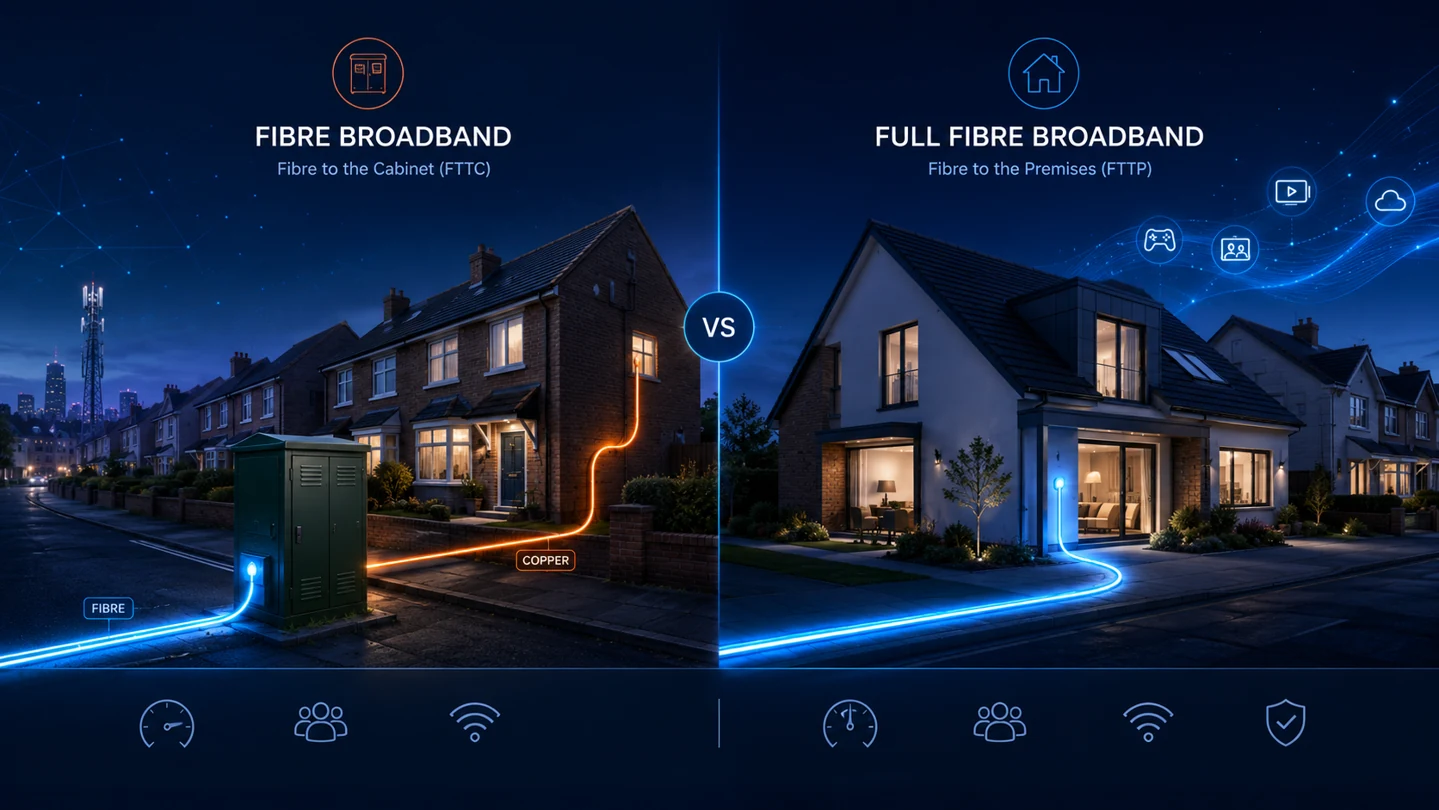
Fibre broadband vs full fibre: the simple version
If you only want the short answer, here it is: full fibre is usually the better option where available. It can offer faster speeds, stronger upload performance and more consistent reliability. Standard “fibre broadband” can still be perfectly usable, but it often relies on copper for the last stretch into the home.
| Feature | Fibre broadband (FTTC) | Full fibre (FTTP) |
|---|---|---|
| How it reaches your home | Fibre to cabinet, copper to property | Fibre all the way to the property |
| Typical speed potential | Good for general browsing and streaming | Higher speed potential, including gigabit-class packages |
| Upload speed | Usually lower | Usually much better |
| Distance sensitivity | Can worsen the farther you are from the cabinet | Not affected in the same way by cabinet distance |
| Best for | Lighter households where full fibre is not available | Busy homes, remote work, gaming, large downloads and multiple users |
What is fibre broadband?
In the UK, fibre broadband often means FTTC. Fibre optic cable runs from the exchange to a local street cabinet. From that cabinet to your home, the signal still travels over older copper wiring.
This is much better than old ADSL in many cases, but performance can depend on the quality of the copper line and how far your home is from the cabinet. Two homes on the same package may not get the same experience.
What is full fibre?
Full fibre, commonly called FTTP, means fibre optic cable runs all the way to the premises. There is no copper last leg in the same sense as FTTC.
That makes full fibre attractive for modern usage: 4K streaming, remote work, cloud backups, smart-home devices, gaming and homes with many connected users. It also gives providers more room to offer higher speeds and often better upload performance.
Why marketing terms can be confusing
Some broadband adverts simply say “fibre” without making it obvious whether the service is FTTC or FTTP. That does not necessarily mean anything is wrong — it just means you should check the connection type carefully if you specifically want full fibre.
A provider page or checker may mention terms like:
- FTTC — fibre to the cabinet
- FTTP — fibre to the premises
- Full fibre — usually another way of describing FTTP
- Gigabit broadband — often available over full fibre, though not every full fibre package is gigabit
Speed is not the only difference
People often focus on headline download speeds, but there are other practical differences too.
Upload performance
Full fibre usually gives better upload speeds, which helps with video calls, sending large files, cloud storage and livestreaming.
Consistency
FTTP is generally less dependent on copper-line quality and cabinet distance, so performance can be more predictable.
Future-proofing
Full fibre is the more future-facing option for households expecting more devices and more demanding online activity.
Which should I choose?
Choose full fibre if it is available at your address and the price and contract terms suit you. It is usually the stronger all-round option for performance and long-term flexibility.
Choose standard fibre broadband if:
- full fibre is not yet available where you live
- your usage is relatively light
- the FTTC package is significantly cheaper and still meets your needs
For browsing, HD streaming and lighter household use, FTTC may still be enough. For heavy use, working from home, gaming, 4K streaming and lots of simultaneous devices, FTTP is usually the better fit.
How to tell what you currently have
If you already have broadband and are unsure whether it is FTTC or FTTP:
- Check your provider account or contract summary.
- Look for wording such as FTTC, FTTP, full fibre or gigabit.
- Use an address-level availability checker.
- Compare your real speed-test results with your package description.